

News from the Chief of Staff for Physicians
Dear Colleagues,
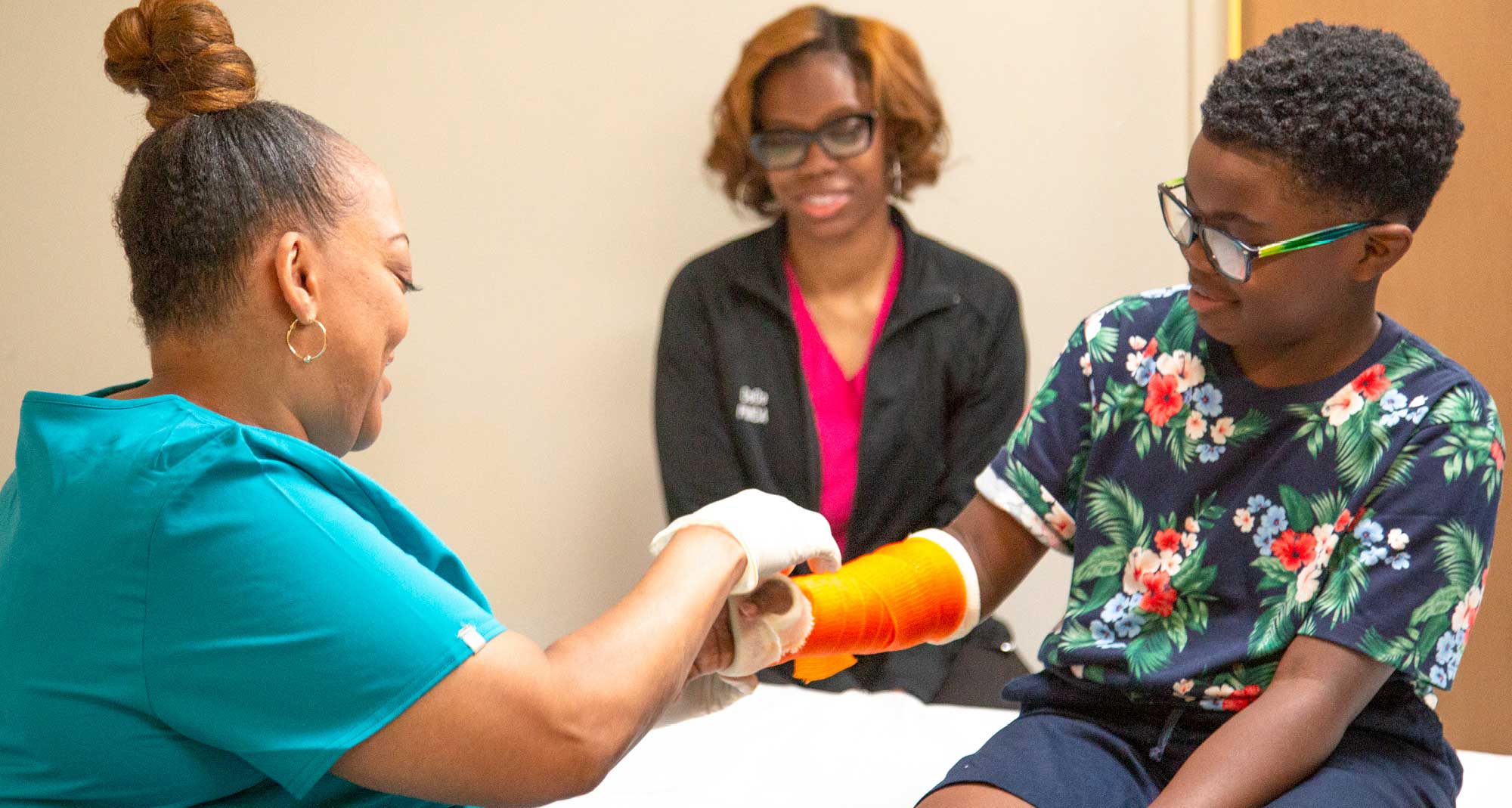
As you all know from an increasing body of evidence, care which includes the family in diagnosis, decision-making and treatment results in better outcomes for patients. At The Children’s Hospital of Michigan, family-centered care is central to the way we treat children and their families. It affects how we design our hospital and clinic space, communicate with patients and families, and develop policies and programs. In this issue of Just for Docs, you will learn about how other physicians view family centered care and how it affects their practices.
The CME Lecture Series has been well attended by generalists and specialists alike. As part of our commitment to offer continuing education opportunities, another CME conference is scheduled for October 13 in the Children’s Hospital auditorium. Also in the next issue of Just for Docs, look for information about Children’s Hospital sports medicine community clinic.
Children’s Hospital organized a Summer Safety Fair at its After-Hours Novi Urgent Care facility located at 41925 West 12 Mile Road in Novi, Michigan. The affair was both fun and educational. An increased number of injuries among kids occur in the summer due to outdoor activities. We organized this event to let parents now that our Novi Urgent Care staff is available on weekends and evenings ready to provide expert care.
This year marked the 50th anniversary of Children’s Hospital of Michigan Annual Clinic Days. We hope many of you had the opportunity to attend what was an exciting series of events held on May 31and June 1. Great speakers, food, and camaraderie made for a celebratory mood for all who attended. Be sure to check out some of the photos from Clinic Days featured in this issue.
As always, I welcome your questions, comments and ideas at tell-mla@dmc.org. I hope you are all finding time to enjoy this beautiful summer.
Sincerely,
Mary Lu Angelilli, M.D.
Children’s Hospital of Michigan, Chief of Staff
Hot Topic: Family-Centered Care
Dr. Mark Frederick Riederer, an assistant professor of pediatrics at Wayne State University School of Medicine, came to Children’s Hospital in 2004 from Cincinnati Children’s Hospital Medical Center. He received his doctor of medicine degree from Boston University School of Medicine and served an internship and residency in categorical pediatrics from Cincinnati Children’s Hospital Medical Center/University of Cincinnati. In addition to providing care to pediatric patients, Dr. Riederer is the director of the Rapid Response Team at Children’s and an active member of the family-centered care committee.
A strong proponent of family-centered care, Dr. Riederer believes it is a particularly important concept in pediatrics. “Very young children can’t tell me what hurts or how they feel,” he explains. “I must rely on their parents to fill me in. And when I include parents in the examination, it calms the child, makes my job easier and is safer for everyone. It also is important that parents play a collaborative role with older children. They are able to give us information about their child and his or her activities that can be just as useful to us as an x-ray film or blood test. And when we need help explaining treatments or requiring behavior changes, parents can partner with us as educators.”
Dr. Riederer says that the collaborative approach of family-centered care is relatively new and, in some instances, not within the experience of some physicians.
For instance, having the family present at rounds or during the placement of a gastric tube is potentially frightening and uncomfortable for parents. Physicians who are not used to having parents present at these events may be equally uncomfortable. He says the key is in the training of physicians during residency so that family-centered care becomes the norm. Another important area is in hospital design–providing more private rooms and larger spaces to encourage discussions that include parents.
“We need to find the balance,” continues Dr. Riederer. “Family-centered care is a two-way street involving collaboration and openness from both physicians and parents. It is the future of medicine and according to the American Academy of Pediatrics is best for child, family and physician. Informal studies have shown that the family-centered care approach positively affects outcomes, increases satisfaction and decreases length of stay. Parents are the most important thing in a child’s life. You can’t leave them out. ”
Physician Profile: John D. Roarty, M.D.
NAME: 
John D. Roarty, M.D.
Chief of Ophthalmology; Local Residency Program Director; Department of Ophthalmology; Co-Director, Retinoblastoma Treatment Group, Children’s Hospital of Michigan and Assistant Professor, Department of Ophthalmology, Wayne State University School of Medicine, Wayne State University, Kresge Eye Institute.
MEDICAL DEGREES:
Medical, Wayne State University School of Medicine
Detroit, Michigan
Masters of Public Health and Epidemiology,
University of Michigan, Ann Arbor, Michigan
PEDIATRIC INTERNSHIP AND RESIDENCY:
University of California-Davis, Sacramento, California
Henry Ford Hospital, Detroit, Michigan
Why did you decide to practice at Children’s Hospital of Michigan?
I was looking for a children’s hospital in a university setting. There was an opportunity available here at Children’s. This made it a good fit because this is home.
What role does the family play in the care of patients?
We consider our patients and their families to be our partners in care. One of the greatest advances is the internet for both basic and complex information. This knowledge contributes to their awareness and understanding, which enables them to help us work with their children.
What are some of the differences in private versus hospital practice?
Both settings offer the opportunity to work with a wide variety of patients. In my private practice, the pace is somewhat slower and I have more direct involvement with patients. At Children’s Hospital of Michigan, in addition to seeing patients, I am involved in research and teaching. I get referrals from all the subspecialties and also have the opportunity to work with more difficult and challenging problems.
Has ophthalmology care improved significantly since you began your practice?
In the last 20 years, treatment options have increased for children with glaucoma and retinoblastoma. With glaucoma, we have gotten much more skilled at monitoring intraocular pressure. In addition, we now have smaller shunt tubes available, which allow us to decrease pressure by increasing the outflow of fluid from the eye. In the treatment of retinoblastoma, chemotherapy agents traditionally used to treat brain cancers are now being used successfully. In conjunction with improved local therapies to shrink tumors in the eyes. We have learned that hyperthermia, in combination with other therapies, creates a synergistic effect that is now
standard therapy in treating retinoblastoma. And within the last year, Children’s has become part of a multi-center research trial that is looking at retinoblastoma treatments, agents and modalities. The trials were established by the Children’s Oncology Group under the direction of Anna Meadows, chief of pediatric hematology/oncology at Children’s Hospital of Philadelphia.
Why is Children’s Hospital of Michigan important to this community and the region?
The entire staff is dedicated and oriented to the care and comfort of children and their families, regardless of their ability to pay. We see children with the most difficult and challenging problems and through our affiliation with Wayne State University and the Kresge Eye Institute, we have access to the latest research to treat them. Children’s Hospital is a main cataract and lens implant surgery center, with families coming to us from throughout the state of Michigan. As a teaching institution, we are responsible for the education of future physicians. And we know that one of the best ways to learn is to teach. It stimulates you to be the best doctor you can be, and to continue learning.
Private Practice Profile: TrueCare Asthma and Allergy Center
PHYSICIAN NAME:
Thomas James Trueheart, M.D., FACAAI
TrueCare Asthma and Allergy Center
21700 Northwestern Highway
Suite 1290
Southfield, MI 48075
248-395-CARE (2273)
www.truecareasthmaandallergy.com
MEDICAL DEGREE:
SUNY Upstate Medical University
Syracuse, N.Y.

RESIDENCY:
Pediatrics
1983-1986
Children’s Hospital of Michigan
Detroit, MI
FELLOWSHIP:
Allergy and Immunology 1986-1988
Detroit Medical Center
Detroit, MI
What led you to private practice?
I have always had the desire to have my own practice. But, after completing my Fellowship, for various reasons, it wasn’t the right time. Nonetheless, always present were family members and very close friends speaking encouraging words that I should venture out on my own. Sixteen years later, during an ENT visit, Dr. Jack Clark showed me a vacant suite adjacent to his office. Immediately, I felt “at home” and I could no longer resist. That was three years ago–the beginning of the TrueCare Asthma and Allergy Center.
What makes your practice unique?
I am the only African-American allergist, also board certified, in this entire Detroit-Southfield area. Our motto says, “Not only do we treat, but we teach.” African-American communities are disproportionately and more severely affected by asthma and allergies. I believe in the team approach; and it is extremely important that my office works closely with the patient, patient’s family, and the referring pediatrician or primary care physician. If I can teach patients as to why we do what we do and what it is that we are trying to achieve, that will put everyone on the same page and a step ahead of the game. Our office specializes in the treatment of asthma, wheezing, persistent coughing, hay fever, sinusitis, dry skin, eczema, hives, bee stings, food allergies, and medications and latex reactions. We provide extensive patient education; allergy testing for all allergens including food, pollen,
bee stings, and wasps; patch test for contact irritants such as cosmetics, aftershave, jewelry, creams, ointments, and rubber boots; full-scale asthma testing; pulmonary function test; and immunotherapy.
What do you find most challenging as a private practice physician?
My greatest challenge is getting the word out about my practice. The next biggest challenge is non-compliance and the lack of understanding and misinformation about asthma and allergies. This lack of information pertains to the myths, etiology, diagnosis, and treatment of asthma and allergies. Education must go hand-in-hand with treatment such that patients establish an Asthma Action Plan, understand the significance of skin testing, addressing steroid phobia, and the technical use and understanding of peak flow meters, inhalers, and nebulization machines. Through appropriate education and management, one can overcome unnecessary fears and needless sports and life restrictions. Ideally, asthma should not take a person’s breath away; nor should allergies take a person’s fun away.
Why do you refer patients to Children’s Hospital of Michigan?
I trained at Children’s Hospital. I know first-hand how great this place is. I know the commitment it has to providing quality medical care. The hospital staff is personable, compassionate, sensitive, and caring and my patients love the fact that when sent to Children’s ER, they are seen in 29 minutes.
CHM Celebrates 50 years of advances in pediatrics
Children’s Hospital of Michigan was proud to present the 50th Annual Clinic Day program. Clinic Day began with the Children’s Hospital of Michigan Alumni Association Dinner & Awards Presentation at the Detroit Golf Club on May 31st, followed by a day-long scientific program and catered lunch at CHM on June 1st. The conference was attended by health care professionals who work with children, physicians, nurses, pharmacists, social workers and students. The event was a huge success.