
Recent News and Stories
Michigan’s first commercially available sickle cell disease gene therapy patient: “A huge blessing,” says 24-year-old Southfield college student
Single lifetime treatment can help avoid ongoing transfusions, SCD symptoms
Detroit – Southfield college student Chantez Sanford Jr. said he wasn’t scared to be the first patient in Michigan to receive a novel, new, commercially available gene therapy to potentially cure his sickle cell disease.
“Faith and joy definitely overtook the fear,” said the Savannah College of Art & Design 3-D animation student, who volunteers as a student minister and Bible study teacher at school in Atlanta and one day hopes to work on movie or video game animation.
 Chantez underwent Lyfgenia transfusion on Dec. 2, 2025 at the Children’s Hospital of Michigan, the first patient in Michigan to complete the treatment since it became commercially available.
The 24-year-old had been undergoing monthly blood transfusions at Children’s Hospital of Michigan since he was 8 years old, after a routine blood test required at birth by the state of Michigan detected sickle cell disease. The inherited genetic condition in which flexible, disc-shaped red blood cells become rigid and crescent or sickle-shaped, had stunted Chantez’s growth and affected his development until the transfusions began, his mother said.
“A couple of years ago, we heard whispers the FDA had something they were going to approve,” said Chantez’s mother, Tamara Sanford.
Those whispers were about Lyfgenia, a process approved by the FDA in December 2023 in which the patient’s blood stem cells are harvested and a gene is added that helps the body make hemoglobin that prevents red blood cells from becoming sickle-shaped. The modified cells are then transplanted back into the body, potentially curing the disease.
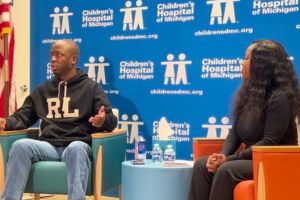 While Chantez did not experience the pain of sickle-shaped red blood cells obstructing blood vessels and damaging tissue, he was ready to try the treatment after years of monthly blood transfusions and hospitalizations due to high fevers and painful episodes. He was not able to receive a bone marrow transplant from a sibling, often a cure to the disease; his brother was not a match.
“Having sickle cell disease has been confusing,” he said. “Spending time in the hospital frequently for blood transfusions and getting sick often – it’s just a confusing feeling. But I did have a pretty regular childhood, despite the sickle cell.”
He jumped at the chance to undergo the Lyfgenia treatment, with cell collection at Children’s Hospital of Michigan during Summer 2025 and his transfusion in December.
“It felt great, like a huge blessing and miracle,” Chantez said. “It offered a lot of hope for myself and other people.”
Success with Lyfgenia is marked by ongoing blood tests that show the body is producing healthy hemoglobin, improvement in hemoglobin levels without transfusions, and a decrease or elimination of severe vaso-occlusive events (VOEs), or other potential complications of sickle cell disease.
For Chantez, he said the difference after the treatment is noticeable in ways many others would take for granted.
 “I feel more regular,” he said in the Children’s Hospital of Michigan Transplantation and Cell Therapy Clinic this week. “I have more energy, my urine is a better color, I have white eyes, better skin, better hair.”
The Transplantation and Cell Therapy Center at the Children’s Hospital of Michigan is in the process of stem cell collection for a second patient with sickle cell disease to undergo treatment.
“This is a very good outcome!” said Dr. Süreyya Savaşan, medical director of the Transplantation and Cell Therapy Program at the Children’s Hospital of Michigan. “We are very excited about Chantez and the opportunity for other sickle cell disease patients to be free of ongoing transfusions and awful side effects from this heinous disease. It feels great to be able to offer them a potential alternative.”
Genetix Biotherapeutics, Lyfgenia’s manufacturer, has not released how many people have received the sickle cell treatment since it became commercially available. The company said about 150 people nationwide last year applied to be considered for the treatment, which is only available at qualified centers like Children’s Hospital of Michigan.
Sites are chosen based on their expertise in stem cell transplantation, cell and gene therapy and sickle cell disease. The transplantation and cell therapy team at Children’s Hospital of Michigan has performed hundreds of stem cell transplants, including traditional stem cell transplants from matched donors for children with sickle cell and some other genetic diseases as well as certain types of childhood cancers. Children’s Hospital of Michigan also in 2023 became the first qualified treatment center in Michigan to offer gene therapy for the rare condition beta thalassemia, helping patients avoid chronic anemia and a lifetime of blood transfusions.
“Children’s Hospital of Michigan continues to be a beacon of hope for patients throughout the region and the state of Michigan,” Children’s Hospital of Michigan Interim CEO and COO Joshua Ulery said. “With sickle cell particularly affecting the Black community, we are grateful to be able to offer this cutting-edge treatment in the city of Detroit, the largest Black-majority city in the United States.”
For more information on Lyfgenia or other gene therapies, contact the Children’s Hospital of Michigan Hematology and Oncology Clinic at 313-745-5515.
See WDIV NBC Channel 4 TV coverage here